THE CATACOMBS OF PARIS
Empire of the Dead
Paris, France
Beneath the streets of Paris lies an empire of the dead.
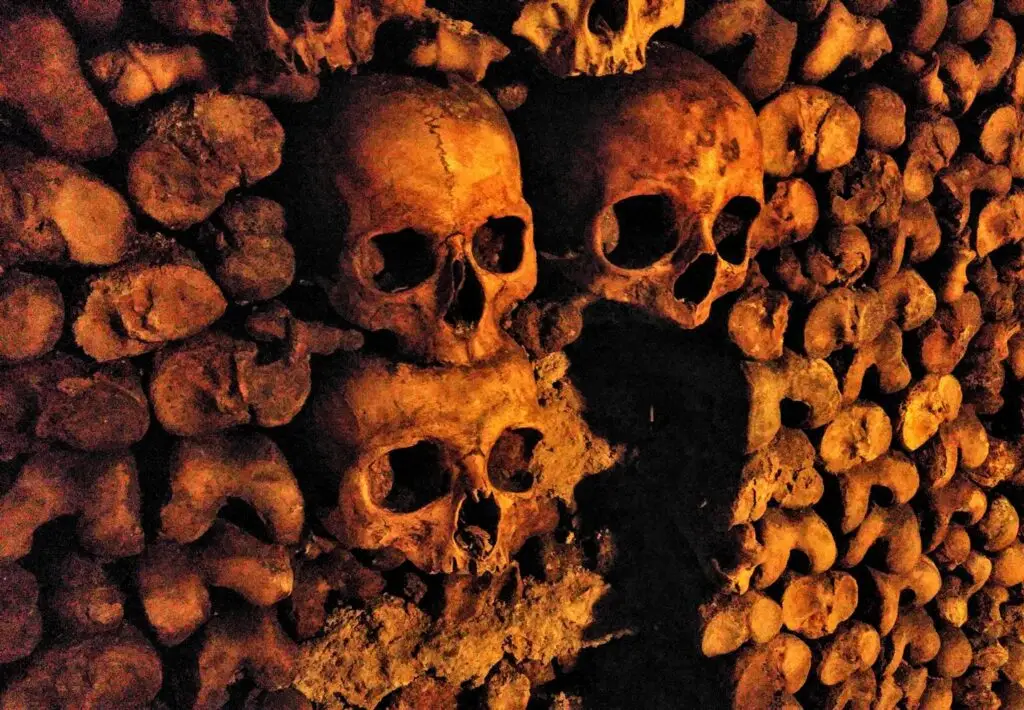
The Catacombs of Paris hold the remains of approximately six million people – their bones removed from overflowing cemeteries in the late 18th century and relocated to the tunnels of former limestone quarries. What was once a practical solution to a public health crisis has become something else entirely: a subterranean ossuary where skulls are stacked in artistic patterns, femurs arranged in decorative walls, and the line between reverential memorial and macabre tourist attraction has long since blurred.
The official route winds through roughly a mile of tunnels, though the catacombs themselves extend for nearly 200 miles beneath the city – a vast, unmapped darkness where it’s entirely possible to become lost. Permanently.
A VISIT TO THE EMPIRE
In 2000, my wife and I descended the 130 steps down into the catacombs as part of the official tour. The temperature dropped immediately – that particular cold that has nothing to do with weather and everything to do with being deep underground, surrounded by stone and the dead.
The atmosphere was heavy. Not metaphorically – literally heavy, as if the air itself had weight. Each breath felt deliberate. The darkness pressed in from beyond the limited lighting, and you couldn’t help but think about what lay in those unlit tunnels branching off from the tourist route.
The tour is semi-guided at best. They corral you into certain tunnels to prevent wandering, but otherwise you’re left to make your own way through at your own pace. Which means you can linger. You can stand in archways where thousands of skulls are stacked in careful arrangements and consider the mathematics of mortality.
We had brought a ghost hunting app on my wife’s phone – an EMF detector. More out of curiosity than any serious expectation.
At one particular archway, surrounded by walls of stacked skulls arranged in meticulous patterns, we turned it on.
It red-lined immediately.
Our reaction was oddly matter-of-fact: Well, of course.
Down there, surrounded by the remains of six million people, arranged in artistic exhibitions of death, it would have been stranger if nothing registered at all. The EMF readings fluctuated as we moved through the tunnels – sometimes high, sometimes normal, always responding to something we couldn’t see or measure by conventional means.
The heavy air never lifted. That sense of presence – of being in a place where the boundary between life and death has worn thin through sheer volume of mortality – never left us.
THE LOST
The same week we visited, two tourists managed to get lost in the catacombs. They spent the entire night in those tunnels, in the dark, surrounded by millions of the dead, trying to find their way back to the official route.
Think about that for a moment.
The temperature never rises above 57 degrees Fahrenheit down there. The tunnels branch endlessly into unmapped darkness. There are no lights beyond the tourist path. And the walls are made of human bones – thousands upon thousands of hollow eye sockets watching you stumble through the black.
They were found the next day, shaken but alive.
One wonders what they experienced in those hours of darkness. What they saw, what they heard, what they felt in that empire of the dead when the lights went out and they were truly, utterly alone with six million silent residents.
They haven’t spoken publicly about their experience.
Perhaps there are some things better left in the dark.
THE HISTORY
The Paris Catacombs were created out of necessity. By the late 1780s, the city’s cemeteries – particularly the Cemetery of the Innocents – had become overfilled to the point of public health crisis. Bodies were barely covered, the smell was overwhelming, and cemetery walls were collapsing under the weight of too many dead.
The solution was practical: move the bones to the abandoned limestone quarries beneath the city.
What wasn’t practical was what happened next. Someone – perhaps out of respect, perhaps out of some aesthetic compulsion – began arranging the bones. Creating patterns. Stacking skulls in decorative formations. Turning a repository of the dead into something that resembled art.
The entrance bears an inscription: “Arrête! C’est ici l’empire de la Mort”
Stop! This is the empire of Death.
It’s not a metaphor. It’s a warning.
WHAT LIES BENEATH
The official tour shows you perhaps one mile of tunnel. The catacombs extend for nearly 200 miles beneath Paris – most of it closed to the public, unmapped, dangerous. Urban explorers known as cataphiles still venture into the illegal sections, risking fines, imprisonment, and worse.
Because there are stories, of course. There are always stories.
Reports of voices in empty tunnels. Shadows that move against the light. The feeling of being followed by something that stops when you stop, breathes when you breathe. Areas where EMF detectors spike for no apparent reason – or perhaps for the most apparent reason of all.
Six million people rest in those walls. Six million lives, loves, fears, hopes, all reduced to bone and arranged in patterns for tourists to photograph.
Is it any wonder that some of them might still linger?
Is it any wonder that the air feels heavy, that the darkness seems aware, that electronic equipment behaves strangely in the presence of so much accumulated mortality?
The Catacombs of Paris are not haunted in the traditional sense – there are no specific ghosts, no individual spirits with stories to tell. The haunting is collective, atmospheric, undeniable. It’s the weight of death itself, concentrated in one place, pressing down on the living who dare to descend into the empire below.
VISITOR INFORMATION
The Catacombs of Paris are open to the public, though space is limited and advance reservations are strongly recommended. The temperature remains constant at 57°F (14°C) – bring a jacket. The tour involves significant walking and 130 steps down (and back up).
Stay on the marked path. The penalties for venturing into unauthorized sections are severe, and the risk of becoming lost is very real.
And if you bring an EMF detector or similar equipment, don’t be surprised when it registers something in those tunnels.
After all, you’re never really alone down there.